Still Moving Forward: Bob Quinlan’s Journey Through Stroke and Recovery
For most of his life, Bob Quinlan has believed in pushing forward.
A lifelong runner, community volunteer and familiar face throughout the area, Bob spent decades challenging himself physically while giving his time generously to others. He helped organize local races, supported community causes and logged enough miles over the years to equal a trip around the world.
So when a stroke suddenly changed nearly every part of his daily life, standing still was never going to be the end of Bob’s story.
It would, however, take time, determination and an extraordinary team of people to help him find his way forward.
“When I first started, it wasn’t the best,” Bob recalled. “I got to the point where I was crying at times because I didn’t know whether I could do this. that, or anything.”
What helped him keep going, he says, were the people around him.
“They showed me how to do it better,” Bob said. “These folks know what they’re doing. Allied is the best. The absolute best.”
A sudden change
Bob’s first stroke came in 2018 after a series of falls in which he struck his head. His wife, Judy, remembers coming home one day and hearing unusual sounds from another room in the house. At first, she thought Bob was on the phone joking with someone. Then she realized he was trying to say her name but could not get the words out correctly. She found him on the floor and called for an ambulance.
Doctors discovered a significant brain bleed that required surgery. When Bob eventually arrived at Allied Services for inpatient rehabilitation, Judy said the energetic, fiercely independent man she knew had changed dramatically.
“He didn’t want to eat. He didn’t want to move. He didn’t want to do anything,” she said.
Their daughter, Erin, a teacher who was home for the summer, spent her days encouraging him not to give up. Then Bob met members of his Allied Services rehabilitation team. Physical therapist Suzanne Jones was among the first to challenge him to get moving again.
“She couldn’t have done a better job for a man who wanted absolutely no part of it whatsoever,” Judy said. “But she insisted. And she did that with love, concern and compassion.”
Occupational therapist Iris helped Bob relearn daily activities. Speech therapy helped him rebuild communication skills. Slowly, the man who wanted nothing to do with rehabilitation began to rediscover the determination that had carried him through thousands of miles as a runner.
The therapists understood something important about Bob, Judy said: independence mattered deeply to him.
“They delved into the fact that Bob is a man who wants to be independent, who wants to do things on his own,” she said. “With a lot of love and a lot of gentle persuasion, they were able to accomplish that.”
Bob spent roughly two months in inpatient rehabilitation before returning home. He transitioned almost immediately to outpatient therapy and continued his recovery.
Facing another stroke
Years of progress were tested again in 2025, when Bob woke one morning with a headache that would not go away. Judy took him to be evaluated and imaging revealed another stroke caused by a smaller bleed. This time, however, things were different.
There had been no dramatic loss of function, and Bob soon began feeling better. Still, Bob and Judy knew where they wanted to turn for rehabilitation. They returned to Allied Services.
Bob completed another period of inpatient rehabilitation before once again transitioning to outpatient care.
The familiar faces, routines and encouragement helped him continue moving forward.
“There’s nothing like where we are (Allied),” Bob said. “It’s a wonderful place. It really is.”
For Bob, Allied Services has become more than somewhere he comes for therapy. It has become a community. He talks with other patients, encourages them and celebrates what they are learning to do. Staff members throughout the building know him by name.
And Bob is still setting goals.
Running again
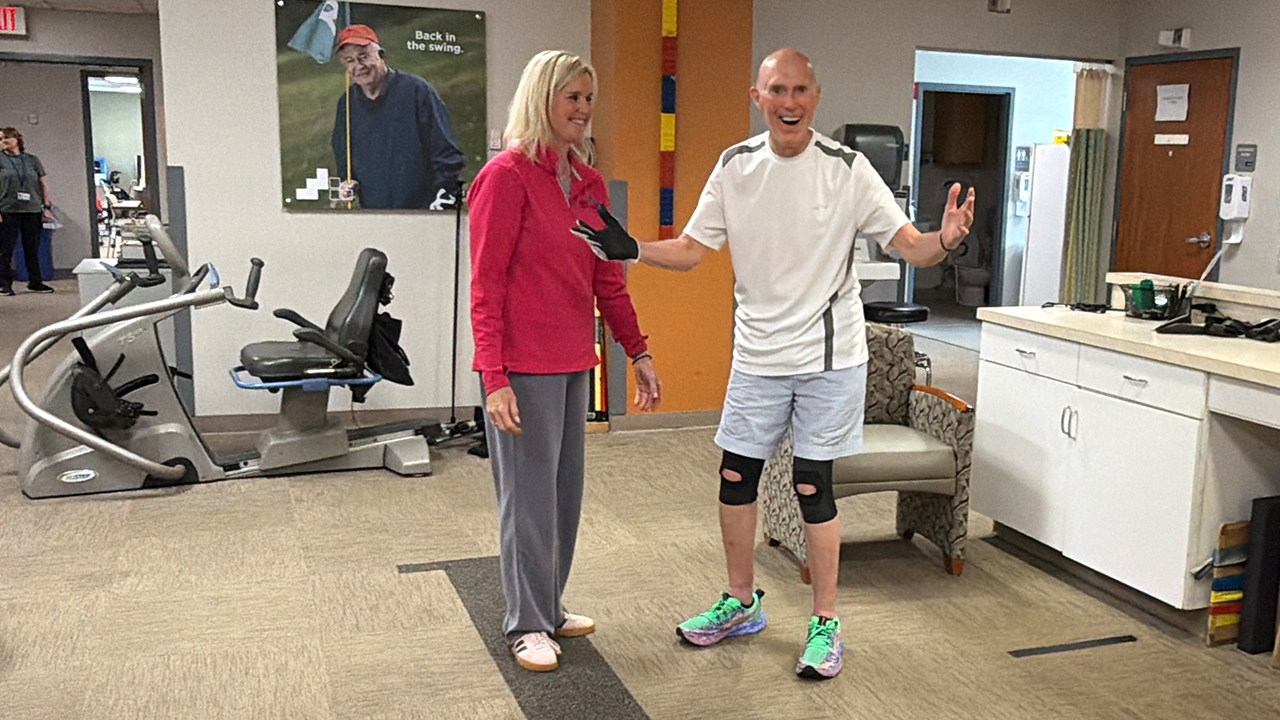
Exercise remains central to Bob’s life. In addition to outpatient rehabilitation, Bob works one-on-one with a trainer and participates in CrossFit-style workouts. When the weather cooperates, those sessions include going outside to run.
His pace may be different today, but the significance is not.
“That’s what he wants,” Judy said as she watched him run during a recent therapy session. “He wants to run.”
For Judy, seeing those moments can still be emotional.
After everything they have experienced together, she sees her husband’s personality fully present again - his humor, optimism, attention to detail and willingness to offer an opinion.
Recently, she joked, Bob told her he did not approve of the pants she was wearing. Then he decided her hair needed fixing.
“He is 100% back to the way he was,” Judy said with a laugh.
That includes his sense of humor.
More than recovery
For Bob and Judy, the past eight years have been filled with difficult days, small victories and milestones they once could not have imagined. The experience has also shown them that rehabilitation is about far more than physical strength.
It is about understanding the person behind the diagnosis. It is about knowing when to challenge someone and when to encourage them.
It is about patience, trust and compassion. And it is about helping people rediscover the parts of life that give them joy and purpose.
For Bob, that has always meant moving forward.
“You see other people doing things,” Bob said of his time at Allied Services, “and there are things that I haven’t been able to do, and now I think, ‘I CAN do things.’”
After two strokes and years of rehabilitation, Bob Quinlan is still making progress.
“At the end of the day, I try to go as hard as I can,” he said. “I’m getting tired, but that’s when you try to go harder. Because that’s when you want to feel the best.”